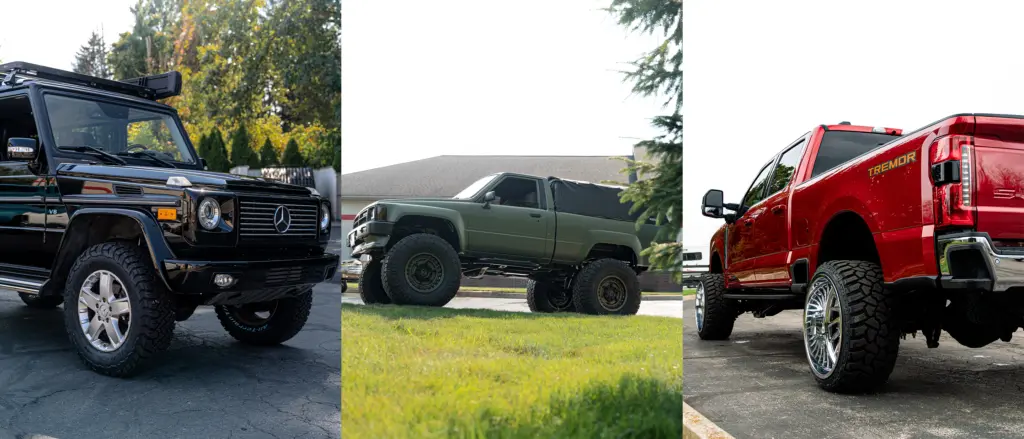
image

LIFTED RIGHT THE FIRST TIME

A lift kit isn't just a parts swap. The type of lift you choose (leveling kit, body lift, or full suspension lift) determines how much ground clearance you gain, what tire sizes you can run, how the truck handles on and off road, and what follow-up work is required. Get the kit selection wrong, and you're either under-built for what you wanted, or you've got geometry issues that show up in tire wear and handling feel six months later.

We install lift kits from Rough Country, Teraflex, Fabtech, BDS, Skyjacker, and ReadyLIFT at both our Lewis Center and Hilliard locations. Every lift install includes a post-lift alignment to bring the truck back to correct geometry for the new ride height. We've been doing this kind of suspension work on Central Ohio trucks and SUVs since 1999. Before we order anything, we talk through what you're actually trying to accomplish: trail capability, a specific look, larger tire fitment, or some combination.

SCHEDULE WITH US

LIFT KIT OPTIONS FOR YOUR TRUCK OR SUV

The right lift depends on your goals, your vehicle, and your budget. Here's how the main options differ and what each one delivers.

Leveling Kits

A leveling kit raises the front of the truck to match the rear, eliminating the factory rake. Most trucks come from the manufacturer with the front sitting 1 to 2 inches lower than the rear for payload reasons. A leveling kit corrects this for a more level stance and allows for larger tires up front without rubbing. It's the least expensive lift option and a common starting point for truck owners who want a cleaner look without a full suspension overhaul.

Body Lifts

A body lift raises the cab and bed off the frame using spacer blocks, adding clearance between the body and the frame without modifying the suspension geometry. This allows for larger tire fitment and a taller stance without the cost of a full suspension lift. The limitation is that it doesn't increase suspension travel or improve off-road geometry. It raises the body, not the suspension.

Suspension Lifts

A full suspension lift modifies the suspension components themselves, replacing springs, control arms, shocks, and other hardware, to raise the entire vehicle uniformly. This delivers real increases in ground clearance, suspension travel, and off-road capability. It's the most involved installation and requires a post-lift alignment. For serious off-road builds or trucks running significantly larger tires, a suspension lift is the right call.

Post-Lift Alignment & Setup

Every lift requires a post-lift alignment. Raising the truck changes the caster angle on the front suspension, and factory alignment specs no longer apply at the new ride height. We include alignment as part of every lift installation. If you're running larger tires after the lift, we also check for rubbing and clearance issues before you drive it out. We handle the full setup, not just the hardware.

YOU NEED A LIFT KIT IF:

  • You want more ground clearance for off-road driving or trail use
  • You're running or want to run larger tires that need more clearance
  • Your truck has factory rake and you want a level, more aggressive stance
  • You're building out a dedicated off-road or overlanding setup
  • You want a lifted truck that's been properly aligned and set up from the start
Talk to Our Experts

COMMON LIFT KIT QUESTIONS

  • What's the difference between a leveling kit and a suspension lift?

    A leveling kit raises only the front of the truck to match the rear, eliminating the factory front-to-rear rake. It typically adds 1.5 to 2.5 inches of front lift and allows for moderately larger tires. A suspension lift raises the entire vehicle by modifying the actual suspension components (springs, shocks, control arms) for a more substantial raise and real improvement in off-road capability and suspension travel. Leveling kits are simpler and less expensive; suspension lifts deliver more capability at more cost and complexity.
  • How high can I legally lift my truck in Ohio?

    Ohio doesn't specify a maximum lift height in inches the way some states do, but it does regulate headlight height (max 54 inches from ground to center) and requires that all lighting, bumpers, and safety equipment remain functional and within legal parameters. Practically, lift height is also constrained by your tire size, wheel well clearance, and what the suspension geometry can handle without causing handling or wear problems. We stay current on Ohio regulations and won't install a kit that creates a compliance issue.
  • Do I need bigger tires when I lift my truck?

    Not necessarily. Most leveling kits and smaller suspension lifts (2 to 3 inches) don't require larger tires. They just allow for them. A 4- to 6-inch suspension lift is typically sized to accommodate larger tires, and running smaller tires on a full suspension lift can look undersized and under-utilize the clearance. We'll confirm what tire sizes fit cleanly with the specific lift kit before we start.
  • Will a lift affect my truck's towing or payload capacity?

    A properly installed lift with quality components shouldn't significantly reduce towing capability. That said, a full suspension lift changes the geometry and the center of gravity, which can affect sway and stability under heavy trailer loads. Weight distribution and sway control setups become more important on lifted trucks that tow regularly. We factor this into the recommendation if you tell us towing is a use case. Cheap kits with poor geometry can create real problems under load, which is one reason kit selection matters.
  • Will a lift kit void my vehicle's warranty?

    Not automatically. The Magnuson-Moss Warranty Act protects consumers. It says a dealer can't void your entire vehicle warranty just because you added an aftermarket part. What they can do is deny a specific warranty claim if they can show the aftermarket part directly caused the failure. For example, a CV axle failure on a truck with a poorly installed lift is a harder warranty claim than a failing infotainment screen. The practical answer is: use quality parts, have them installed correctly, and the exposure is minimal. We use established brands and install to spec. If you have a specific warranty concern before moving forward, bring it up, and we'll talk through it honestly.

Contact form

form image

Reviews

Top