
image

GET THE BASS YOUR FACTORY SYSTEM CAN'T DELIVER

Human hearing extends down to around 20Hz at the low end. Factory audio systems typically begin rolling off bass response well above that, because the speakers installed in doors and rear decks physically cannot reproduce those frequencies without distortion or damage. A subwoofer fills in what the rest of the system cannot cover, and the difference is audible across every genre, not just music that is bass-heavy by design. The enclosure type determines how the driver sounds: sealed enclosures deliver tight, accurate bass, while ported designs trade some precision for more output at specific frequencies. For trucks and vehicles with limited cargo space, shallow-mount subwoofers are a practical alternative that don't require giving up the entire bed or trunk.

A proper amp installation matters as much as the subwoofer itself. Too little power or too much will damage it. We design the subwoofer setup around your specific vehicle, available space, and listening preferences before any parts are ordered. Both our Lewis Center and Hilliard locations handle subwoofer and enclosure installation as part of our sound system services. 

SCHEDULE WITH US

SUBWOOFER INSTALLATION SERVICES

From compact powered subs in daily drivers to full enclosed setups in trucks and SUVs, we match the subwoofer system to the vehicle and how you actually use it.

Enclosed Subwoofer Systems

A traditional enclosed subwoofer pairs a woofer driver with a dedicated enclosure, either sealed or ported, that determines much of the system's sound character. Sealed enclosures produce tight, accurate bass that is better suited to music with complex low-frequency content. Ported enclosures produce louder output in a specific frequency range and are popular for high-volume and bass-heavy listening. We will explain the tradeoffs for your application.

Shallow-Mount Subwoofers

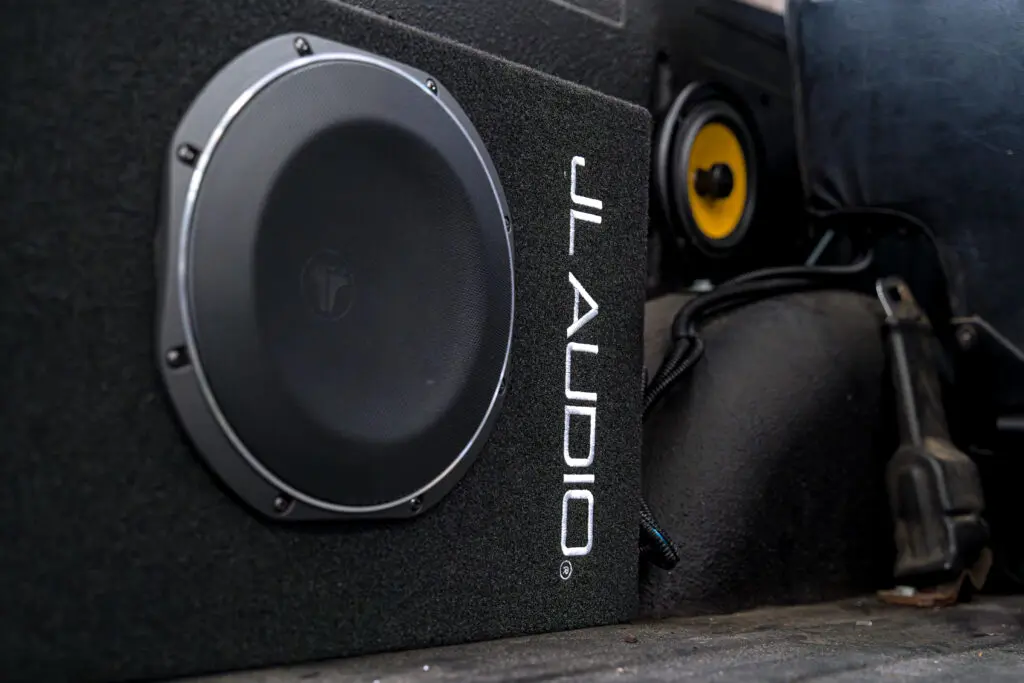
Shallow-mount drivers are designed for vehicles where traditional subwoofer depth is not available: trucks with under-seat storage, small SUVs with limited cargo floor space, or vehicles where the owner does not want to sacrifice usable space. Shallow-mount subs produce less output than a full-depth driver in an equivalent enclosure, but for daily listening in the right vehicle, the tradeoff is often acceptable.

Powered Subwoofer Systems

A powered subwoofer combines the woofer, enclosure, and amplifier in a single compact unit. These are an efficient option for vehicles where space is limited or where adding a separate amplifier is not practical. Powered subs are generally less flexible in tuning than a separate subwoofer and amplifier pairing, but many drivers find the output level and sound quality of a powered unit more than adequate for their needs.

Subwoofer & Amplifier Matching

The amplifier must be matched to the subwoofer's impedance and power handling specifications. An amplifier that delivers too much power damages the driver; one that is significantly underpowered clips the signal and also causes damage over time. Correct matching also involves setting the amplifier's low-pass crossover so the subwoofer only handles frequencies below its useful range, typically 80 Hz or lower.

YOU NEED THIS IF:

  • Your audio system sounds complete at low volume but missing low-end at normal listening levels
  • You drive a truck and want bass without losing the entire back seat or bed access
  • You have upgraded your speakers and amplifier but the system still lacks foundation in the low frequencies
  • You want a compact, powered subwoofer solution that does not take up significant cargo space
  • You are building a full system and want to add a properly matched subwoofer as the final component

COMMONLY ASKED QUESTIONS

  • Why can't my door speakers handle bass?

    Door speakers are designed for midrange and upper bass frequencies. Asking them to reproduce frequencies below 80 Hz requires cone excursion and power handling they are not built for, which causes distortion and accelerates wear. A subwoofer handles those low frequencies correctly, which also reduces the load on your door speakers and allows them to perform better in their intended range.
  • What is the difference between a sealed and a ported enclosure?

    A sealed enclosure is an airtight box. It produces tight, accurate, relatively flat bass response, which suits music where low-frequency accuracy matters: acoustic, jazz, classical, and detailed electronic music. A ported enclosure has a tuned opening that reinforces a specific frequency range, producing louder output in that range at the cost of accuracy below the port tuning frequency. Ported enclosures are popular for high-output setups and bass-heavy music. We will recommend the type that fits your listening preferences.
  • Can a subwoofer be installed in a truck without taking up the entire back seat area?

    Yes. Several options exist for trucks: shallow-mount drivers in under-seat enclosures designed for specific truck models, wedge enclosures that fit in the corner of a seat-back, and compact powered subs that tuck under or behind a seat. Output will be lower than a full-size trunk install, but most drivers find it more than adequate for daily listening. We have installed subwoofers in most common truck configurations and can tell you what fits in your specific cab.
  • Do I need a separate amplifier for a subwoofer, or can my existing amp power it?

    If your existing amplifier has a free channel with adequate power output and includes a low-pass filter, it may be able to power a subwoofer. More commonly, a dedicated mono amplifier matched to the subwoofer's specifications is the better approach because it provides the correct impedance load management, higher current output, and crossover control a subwoofer needs. We will assess your current system and tell you what makes sense.
  • How does subwoofer installation affect cargo or passenger space?

    That depends entirely on the enclosure type and the vehicle. Full-size sealed or ported enclosures in an SUV or trunk car will use some cargo space. Shallow-mount under-seat installs in trucks use minimal space. Powered subs in compact enclosures are often placed behind a rear seat or in a corner of the cargo area with minimal footprint. We design the install with your use of the vehicle in mind and will not suggest a setup that defeats how you use the space.

Contact form

form image

Reviews

Top