
How Potholes Damage Your Suspension (and the Warning Signs to Catch Early)
That clunking noise you started hearing after winter is your suspension telling you a pothole already won. Here’s the part most people miss: the pothole that damages your suspension usually doesn’t announce itself. You feel the jolt, wince, check that the tire’s still holding air, and drive on thinking you got away with it. Weeks later a clunk shows up over bumps, the steering wanders, or your tires start wearing unevenly. That delay is exactly why pothole damage is so easy to ignore until it turns into a bigger repair. Pothole damage cost U.S. drivers a combined $26.5 billion in 2021 according to AAA, with about 1 in 10 drivers needing a repair. Here’s how that damage actually works, and what to listen and feel for before it spreads.
Why a pothole hits your suspension so hard
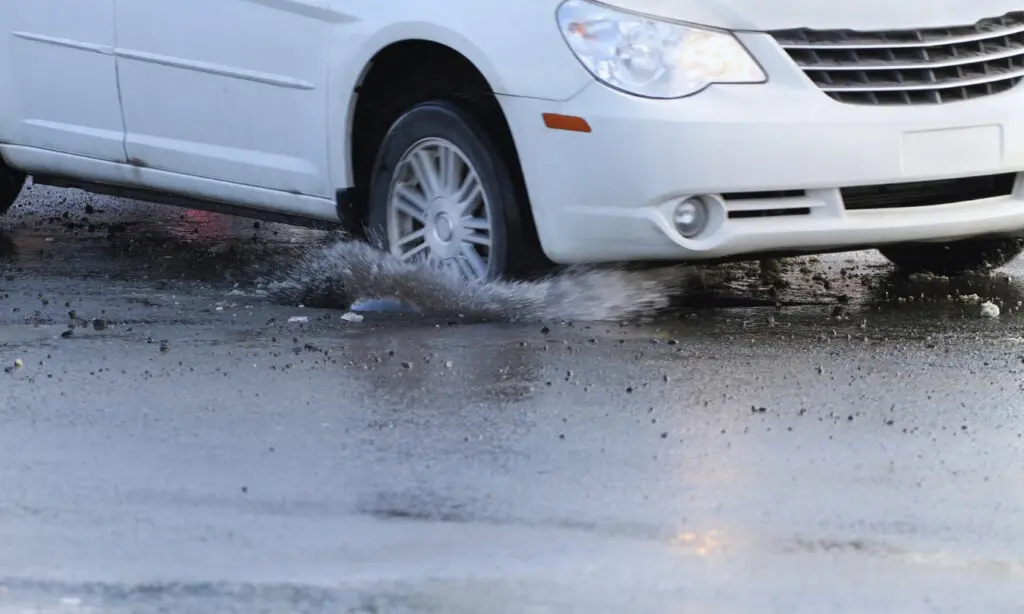
Your suspension exists to absorb road impacts so the rest of the vehicle doesn’t have to. A pothole is the worst-case version of that job. Instead of a gradual bump, the wheel drops into a sharp-edged hole and then slams into the far wall of it. That impact travels up through the tire and wheel and into the suspension components, and because it’s sudden and concentrated, it hits far harder than the gradual flexing those parts are designed for.
The faster you’re going and the harder the edge of the pothole, the more force gets dumped into the system in a fraction of a second. That’s why a pothole you barely noticed at 45 mph can bend something that years of normal driving never would.
The damage chain: how one impact spreads
This is the part worth understanding, because pothole damage is rarely just one thing. The suspension is an interconnected system, and a hard hit sends force through the whole assembly. Here’s the typical chain of what gets damaged, in roughly the order the force travels.
- Tires and wheels first. The tire is the only cushion between the pothole and everything else. A hard hit can pinch the sidewall against the wheel, causing a bulge, a puncture, or a bent rim. A bent wheel never seals or balances quite right again.
- Bushings and ball joints next. These are the rubber and pivot points that let the control arm flex while holding everything in position. A sharp impact can tear or crack a bushing or knock a ball joint loose. Once the rubber is compromised, it deteriorates fast and starts allowing metal-to-metal movement.
- Control arms. The control arm is the link connecting your wheel assembly to the frame. A hard enough pothole can physically bend a control arm, which instantly changes your suspension geometry and throws the alignment out of spec. In severe cases the arm can crack.
- Tie rods and steering components. A pothole impact strong enough to bend a control arm rarely leaves the steering untouched. A bent tie rod often comes along with it, which is why steering wander after a pothole is such a common complaint.
- Shocks and struts. The sudden compression can damage a shock or strut, especially if it was already worn. A blown strut changes how the whole corner of the vehicle handles.
- Alignment, finally. Even when no single part visibly fails, the cumulative shift in geometry knocks the wheels out of alignment. That’s the damage that quietly eats your tires over the following months.
In our experience at the shop, this chain is exactly why we never look at just the part the customer points to. When someone comes in after a pothole with a clunk, we check the whole corner, because the impact that tore a bushing very likely stressed the ball joint and tie rod next to it.
Bad control arm symptoms to watch for
The control arm is one of the most common pothole casualties, and it’s usually the part behind that post-winter clunk. A control arm is built to last the life of the vehicle under normal conditions, but a single hard impact can damage it instantly. Here’s what a failing control arm actually feels and sounds like:
- Clunking or knocking over bumps. The signature symptom. When a control arm bushing tears or a ball joint develops play, the metal parts start making contact they shouldn’t. You’ll hear a distinct clunk going over bumps, potholes, or speed bumps, and often when turning or braking. The noise comes from the bushing or joint letting the control arm shift inside its mounting.
- Steering wander or pulling. A bent control arm can’t hold the wheel at the correct angle, so the vehicle drifts or pulls and you find yourself constantly making small corrections to keep it straight.
- Steering wheel vibration or shimmy. Worn bushings stop absorbing vibration, so it transmits straight to the steering wheel, often worst at highway speeds.
- Uneven tire wear. A control arm that’s altered the geometry tilts the wheel slightly, wearing the inner or outer edge of the tire much faster than the center. Asymmetric wear between the left and right front tires is a classic sign.
The reason to catch these early is safety as much as cost. A failing control arm left long enough can lose its ability to hold the wheel in position, and in a severe case the joint can separate. That’s not a risk worth running.
Why clunking is the symptom you should never ignore
A clunking noise when driving over bumps is the single most common way suspension damage announces itself, and it’s the one people most often put off dealing with. The clunk is almost always metal moving where it shouldn’t, whether that’s a worn control arm bushing, a loose ball joint, a bad sway bar link, or a damaged strut mount.
The trouble is that the clunk rarely gets better on its own and usually gets worse. A small amount of play accelerates the wear on everything connected to it, so a torn bushing you ignore for six months can take the ball joint and tie rod down with it. What could have been one part becomes three. When a vehicle comes into our Lewis Center or Hilliard locations with a new clunk, the cheapest outcome is almost always the one where the customer came in early.
Why Central Ohio is especially hard on suspensions
This is not a universal problem in equal measure everywhere, and Central Ohio drivers get a double dose. Our freeze-thaw cycle is one of the most destructive pavement conditions there is. Water seeps into cracks, freezes and expands, thaws, and repeats, breaking the road apart from the inside until the surface collapses into a pothole. That’s why pothole season explodes every year as winter turns to spring.
On top of that, the road salt that keeps our winter roads drivable corrodes suspension components from the outside, weakening bushings, ball joints, and the control arms themselves so they’re more vulnerable when a pothole hits. The combination is why we see a wave of suspension work every spring, and why an annual undercarriage inspection matters more here than it would in a dry, mild climate.
Common questions we get about pothole suspension damage
How do I know if a pothole damaged my suspension or just my tire?
Start with the obvious: check the tire and wheel for a bulge, a leak, or a visible bend in the rim. If the tire’s fine but you notice new clunking, steering pull, vibration, or the vehicle suddenly tracking differently, that points to suspension or steering damage rather than just the tire. The honest answer is that some damage is only visible on a lift, so if something feels different after a hard hit, it’s worth having the whole corner inspected rather than guessing.
Can I keep driving with a clunking suspension?
You can, but you shouldn’t for long. A clunk means something has play in it that shouldn’t, and that play accelerates wear on everything connected to it. Driving on it turns a smaller repair into a bigger one, and depending on which component is failing, it can become a safety issue if a joint lets go. Get it inspected sooner rather than later. If the steering also feels loose or wandering, treat it as urgent.
How much does pothole suspension damage cost to fix?
It depends entirely on what got damaged, which is why we inspect before quoting. A bent wheel, a torn bushing, a bent control arm, and a damaged strut are all different repairs, and a single hard impact can involve more than one. The reason we look at the whole corner rather than just the part you point to is that the cost depends on the full extent of the damage, and finding all of it upfront is cheaper than discovering the rest later. Come in and we’ll give you a straight assessment of what actually needs to be addressed.
Ready to get that clunk checked out?
If you’ve hit a bad pothole, started hearing a clunk over bumps, or noticed your steering pulling or your tires wearing unevenly, that’s worth having looked at before it spreads to more components. Stop by our Lewis Center or Hilliard location and we’ll inspect the full corner, tell you exactly what the impact damaged, and get your suspension back to spec. You can also see our suspension and steering services here.

STAY CONNECTED
Follow us online to keep up on future updates, discounts, new products, and new projects.


