image

WHEN FACTORY BRAKES AREN'T ENOUGH

Factory brakes are engineered for the average driver on the average road. If you're towing a trailer loaded past 10,000 pounds, running a modified engine that makes significantly more power than stock, or pushing a vehicle hard on a track, those factory brakes are working outside what they were designed for. The result is fade, longer stopping distances, and hardware that wears faster than it should. Upgraded brakes solve that with more friction material, better heat dissipation, and caliper designs built to handle real loads.

We carry performance brake hardware from Brembo, EBC Brakes, Hawk Performance, Baer, Power Stop, and Power Slot, and we've been installing it on trucks, cars, and SUVs in Central Ohio since 1999. The right combination of pads, rotors, and calipers depends on the vehicle and how it's actually being driven. We'll tell you what makes sense for your specific setup and what's overkill for what you're actually doing with it.

SCHEDULE WITH US

WHAT WE INSTALL

We install performance brake components for daily drivers, tow rigs, lifted builds, and track vehicles. Each one matched to your vehicle, your use case, and the hardware you're already running.

Performance Brake Pads

Performance pads use friction compounds designed for higher operating temperatures than OEM pads, which means they hold up better under sustained hard braking without glazing or fading. Hawk, EBC, and Baer each offer different compounds suited for street, street and track, and full track use. We'll match you to the right compound for how the vehicle is actually used.

Slotted & Drilled Rotors

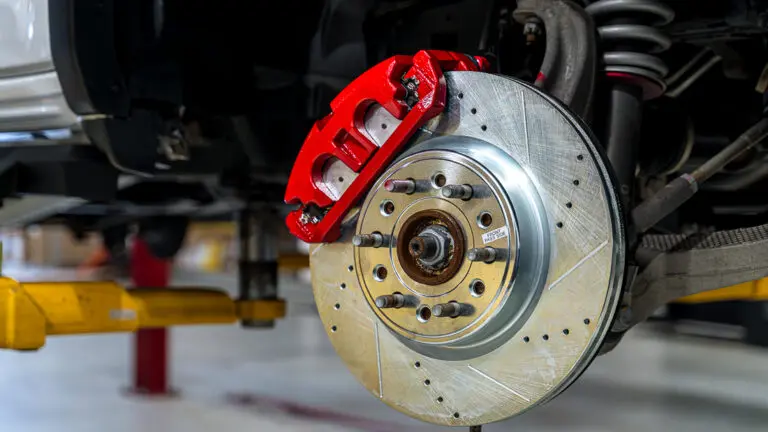
Slotted rotors use machined grooves across the rotor face to channel heat and gases away from the pad surface, which reduces fade and maintains consistent bite under repeated hard stops. Drilled rotors do the same while also reducing unsprung weight, which matters on performance builds and road courses. Power Slot and Power Stop both offer rotor designs across a wide range of vehicle fitments, and we confirm the right rotor spec before ordering anything.

Big Brake Kits

A big brake kit replaces the factory caliper, rotor, and sometimes the bracket with a purpose-built system designed around greater stopping force and better heat management. Baer and Brembo both offer big brake systems for street and track applications, including multi-piston monoblock calipers that are significantly stiffer than OEM hardware. These kits are most commonly installed on vehicles that have had significant engine work done and need the braking system to match the power output.

Caliper Upgrades

Multi-piston calipers apply more even pressure across the pad surface than single-piston sliding calipers, which improves pedal feel and reduces the flex that causes soft or inconsistent stops under load. Brembo and Baer both manufacture aftermarket calipers for a range of vehicle applications. Caliper upgrades are often part of a big brake kit install but can also be done independently depending on the vehicle and the goal.

YOU NEED THIS IF:

  • You tow heavy loads regularly and notice brake fade or longer stopping distances under load
  • You've added significant power to your vehicle and the factory brakes aren't keeping up
  • You track your vehicle and need pads and rotors that can handle sustained heat without fading
  • You've lifted your truck and want hardware sized correctly for the added weight
  • You want better pedal feel and shorter stops on a daily driver or performance build
Talk to Our Experts

COMMON BRAKE UPGRADE QUESTIONS

  • What's the actual difference between performance brakes and factory brakes?

    Factory brake components are engineered to meet the needs of the average driver under normal conditions with adequate stopping power, acceptable pad life, and a reasonable cost. Performance hardware uses better friction materials, improved rotor designs, and in some cases multi-piston calipers that apply more even pad pressure. The practical difference shows up under heat and repeated hard stops. OEM pads can glaze or fade under sustained braking; performance compounds hold up. On a daily driver in normal use, you may not notice much. On a tow rig, a modified car, or a track vehicle, the difference is significant.
  • Do I need to upgrade all four corners?

    Not always. A lot depends on the vehicle and the goal. Front brakes handle the majority of stopping force on most vehicles — typically 60 to 70 percent — so front upgrades alone make a noticeable difference on many builds. That said, a balanced brake system that matches front and rear bias is important, especially on track vehicles where brake balance affects handling. We'll assess your setup and tell you where the upgrade actually makes sense rather than defaulting to a full four-corner kit on every vehicle.
  • Will performance brakes work on my daily driver?

    Yes, with the right selection. Not every performance brake product is designed for daily use. Some track-specific pad compounds require heat to work properly, which means they perform poorly when cold — not ideal for a daily commute. Street and street and track compounds, like many options from Hawk and EBC, are designed to work well both cold and hot, making them a practical upgrade for a daily driver that also sees spirited use. We'll steer you toward hardware that actually fits how you drive.
  • How much does a brake upgrade cost?

    It varies significantly depending on the scope of the work. Upgrading pads and rotors on a single axle is a different job than installing a full big brake kit with new calipers on all four corners. Every job is quoted based on your specific vehicle and what you actually need. Stop by our Lewis Center or Hilliard location, or schedule a consultation and we'll give you an accurate quote once we know the vehicle and the goal.

Contact form

form image

Reviews

Top