
Radar Detectors and Laser Jammers Explained
Here’s the distinction that trips up almost everyone shopping for one of these: a radar detector and a laser jammer are not the same thing, they don’t do the same job, and they don’t share the same legal status. One quietly listens. The other actively fights back. Mixing them up is how people end up buying the wrong device, installing it wrong, or running something that isn’t legal where they drive. So before you spend money on a radar detector or a laser jammer setup, here’s what each one actually does, where the law stands as of 2026, and how to figure out what makes sense for your vehicle.
Radar detectors versus laser jammers: the core difference
The simplest way to understand these is by what they do with a signal.
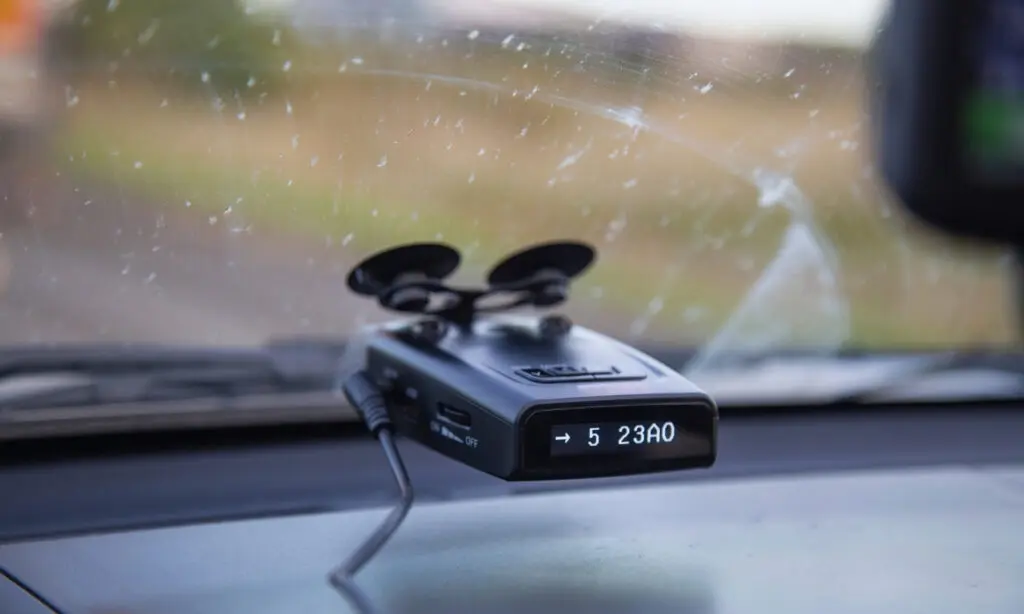
A radar detector is a passive receiver. It listens for the radio waves police radar guns emit on the X, K, and Ka bands and warns you when it picks one up. It doesn’t transmit anything or interfere with the radar. It just tells you the signal is out there. Because it’s passive, it sits in a different legal category than anything that actively interferes.
A laser jammer is an active countermeasure. Police lidar (laser) guns are different from radar. They fire a tightly focused beam at a single vehicle, and they’re so precise that a radar detector often won’t warn you until the officer already has your speed. A laser jammer mounts on the front of the vehicle, detects an incoming laser, and sends light back at the gun to prevent it from getting a clean speed reading, which buys you time to slow down. Because it actively transmits back at the equipment, it’s regulated differently.
There’s also a third device people confuse with these: a radar jammer, which actively transmits radio noise to block police radar. Keep that one straight, because its legal status is not ambiguous at all, as you’ll see below.
The legal picture in 2026
This is the part to get right, because the rules differ by device type and by state, and there’s a lot of outdated and flat-out wrong information floating around online.
- Radar detectors are legal in almost every state for private passenger vehicles. The two exceptions are Virginia and Washington D.C., which both ban them outright. Virginia’s ban is still in force under Virginia Code 46.2-1079, which prohibits operating a vehicle equipped with any device, passive or active, that detects or interferes with police radar or laser. If you see an article claiming Virginia repealed this, it’s wrong. A repeal bill was introduced but did not pass, and the statute remains on the books.
- Radar detectors are also banned federally in commercial vehicles over 10,000 pounds, and on military bases, regardless of state.
- Radar jammers (the RF kind) are illegal in all 50 states. They violate federal law under 47 U.S.C. 333, which prohibits interfering with licensed radio communications. This one isn’t a gray area, and the penalties are serious.
- Laser jammers have no federal ban, and their legality is set state by state. They are prohibited in roughly a dozen states, including California, Colorado, Illinois, Iowa, Minnesota, Oklahoma, South Carolina, Tennessee, Texas, Utah, and Virginia. The exact list shifts as laws get amended and some states are gray areas, so it’s worth confirming your specific state before buying.
For our Central Ohio customers, the practical answer is that radar detectors and laser jammers are both legal for private passenger vehicles in Ohio. Radar jammers, the RF kind, are not, under both federal law and Ohio’s own ban on devices that jam speed-measuring equipment. The catch with laser jammers is that legality can change the moment you cross a state line, so if you regularly drive into a state that bans them, that matters for your setup. We confirm where a given setup is and isn’t legal with customers before installing anything.
What to look for in a radar detector
Not all detectors are the same. The features that actually separate a good one from a frustrating one:
- Range and sensitivity. The whole point is early warning. Higher-end detectors pick up faint, instant-on radar from much farther away, giving you more time to react. This is where the flagship units justify themselves.
- False alert filtering. Modern cars are full of radar-based safety systems (blind spot monitoring, collision avoidance), and automatic doors at every store throw K band. A detector with weak filtering cries wolf so often, you stop trusting it. Good GPS-based filtering and lockouts are what make a detector livable day to day.
- GPS and lockouts. GPS lets the detector remember and ignore known false-alert locations (that grocery store door you pass every morning) and warn you about fixed red light and speed cameras.
- Directional arrows. Better units tell you whether the signal is ahead, beside, or behind you, which is genuinely useful in traffic.
- Display and controls. A bright, readable display and an easy-to-reach mute button matter more than people expect once the device is actually in the car.
On brands, the names that dominate the serious end of the market are Uniden (the R8 and R7 are enthusiast favorites for raw range and customization), Escort (the Redline 360c is the plug-and-play benchmark and is undetectable by the radar-detector-detectors police use in restricted areas), Valentine One (directional, very customizable), and Cobra (the value pick). The honest truth is there’s no single best radar detector for everyone. The right one depends on whether you mostly drive highway or city, how much you want to tinker with settings, and how much false-alert chatter you’ll tolerate.
Windshield-mount versus custom-installed systems
This is where the conversation usually comes into the shop. You can buy a detector off the shelf, stick it to your windshield with a suction cup, and plug it into the 12V outlet. That works. But there’s a real difference between that and a properly installed system.
A custom-installed radar detector or remote system is hardwired, hidden, and integrated. No cord dangling down the dash, no unit advertising itself on your windshield, and the alerts can run through dash-mounted displays or your speakers. Remote and custom-mounted systems like the higher-end Escort and K40 setups are designed to be installed this way, with the components tucked behind the trim and only what you need visible.
Laser jammers in particular are not a stick-it-on-yourself product. The jammer heads have to be mounted at the right height and angle on the front of the vehicle to actually intercept a lidar gun, wired to a controller, and aimed correctly. A poorly placed jammer head is just an expensive decoration. This is the work we do at our Lewis Center and Hilliard locations, and it’s the part that determines whether the system actually performs. We install both Escort and K40 radar detector and laser systems, and the install quality matters as much as the hardware.
Who actually benefits from each
A quick breakdown by driver:
- High-mileage highway drivers. A long-range radar detector earns its keep here. The miles add up, and instant-on radar is exactly what a sensitive detector helps with.
- Drivers in lidar-heavy areas. If local enforcement leans on laser rather than radar, a detector alone often won’t help in time, and a laser jammer is the countermeasure that addresses it (where legal).
- Anyone who wants a clean, factory look. If a cord on the windshield bothers you, a custom-installed remote system is the answer.
- People who cross state lines regularly. Your setup needs to account for the strictest state you drive through, especially with laser jammers.
Common questions we get about radar detectors and laser jammers
Do radar detectors actually work?
Yes, with honest limits. Against traditional radar, a quality detector gives real warning distance, especially on the highway. Where they struggle is instant-on radar (the officer only turns it on when you’re already close) and lidar, which is too focused and fast for a detector to give much warning. That’s the gap laser jammers fill. A detector is a strong tool, not a force field, and it’s not a substitute for paying attention to your speed.
Is a laser jammer legal in Ohio?
Yes. In Ohio, both radar detectors and laser jammers are legal for private passenger vehicles. The important caveat is that laser jammer legality changes by state. Roughly a dozen states ban them, so if you drive into one of those, a setup that’s legal at home can become illegal across the border. Radar jammers are a different device entirely, and those are illegal everywhere, both under federal law and under Ohio’s own ban on jamming speed-measuring equipment. We make sure customers understand where their specific setup is and isn’t legal before installing.
Should I buy a detector off the shelf or have one installed?
Either can be the right answer. If you want a simple, movable unit and don’t mind the windshield mount and cord, an off-the-shelf detector is fine, and you can do it yourself. If you want a hidden, integrated system that looks factory, performs at its best, and includes laser jammer heads that have to be precisely mounted and aimed, that’s a professional install. The hardware is only half of it. With laser jammers especially, placement is the difference between a system that works and one that doesn’t.
Ready to set up the right system for your vehicle?
Whether you want a simple radar detector dialed in for your daily commute or a fully integrated detector and laser system installed clean, we can walk through what fits how and where you drive. Stop by our Lewis Center or Hilliard location and we’ll talk through the options, the legal side for the states you actually drive in, and what makes sense for your vehicle. You can also see our radar detector and laser jammer installation services here.

STAY CONNECTED
Follow us online to keep up on future updates, discounts, new products, and new projects.


