
The Truck Owner’s Guide to Suspension Upgrades
Factory truck suspension is a compromise. The manufacturer doesn’t know if you’ll spend your weekends towing a 7,000-pound camper, hauling sheets of drywall on a Saturday, daily-driving empty for years, or splitting the difference. So they build a setup that works okay for all of those, and great for none of them. That’s the gap a suspension upgrade closes. Whether it’s worth closing for your truck depends on what you actually do with it.
Here’s how we walk customers through the decision at the shop.
What “suspension upgrades” actually mean for a truck
When people ask about suspension upgrades, they’re usually thinking lift kits, but that’s only one branch of it. The full menu for trucks looks like this:
- Leveling kits. Lift the front of the truck (typically 1.5 to 2.5 inches) to match the factory rear height, since most trucks come from the factory with a slight rear rake to account for cargo. Eliminates the nose-down look and lets you fit a moderately larger tire.
- Lift kits. Raise the entire truck for ground clearance and tire size. Range from small body lifts and spacer lifts up through full suspension lifts of 6 inches or more, replacing shocks, springs, control arms, and sometimes drive components.
- Lowering kits and coilovers. Less common on trucks, but real. Drop springs, lowering shocks, or coilover setups for street trucks where handling and stance matter more than ground clearance.
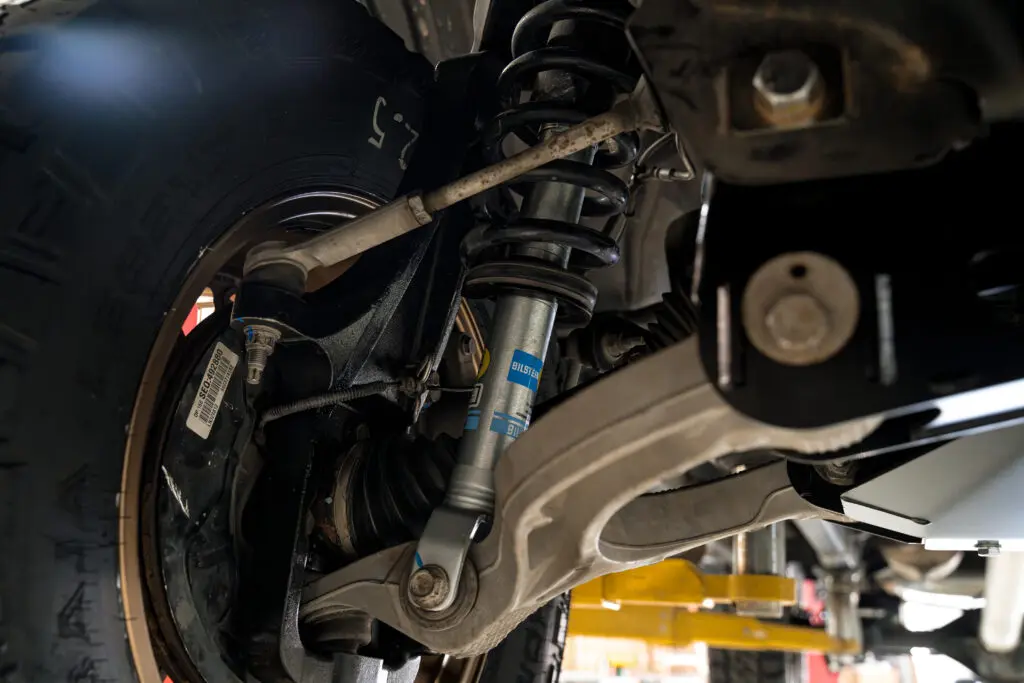
- Heavy-duty shocks and springs. Without changing ride height, you can replace tired shocks with performance units (Bilstein, Fox, King), upgrade rear springs for load capacity, or add helper springs and airbags for variable load support.
- Sway bars, control arms, and bushings. The unsexy stuff that actually changes how the truck handles. Upgraded bushings tighten everything up; aftermarket control arms allow more travel on lifted trucks; bigger sway bars reduce body roll under load.
A “suspension upgrade” can be any one of these, or several stacked together. The right answer for your truck depends on which problem you’re actually solving.
The truck-specific reasons to upgrade
This is where most articles go generic. Trucks are different from cars in suspension terms because they get asked to do contradictory things. The factory tune-up doesn’t always handle that well. Real reasons we see customers come in:
You tow or haul, even occasionally.
Factory rear springs sag under load. The truck squats, the headlights point at the sky, the front end goes light, and the steering becomes less articulate. Upgraded rear springs, airbags, or helper springs keep the truck level under load. This isn’t about exceeding the towing capacity; it’s about how the truck behaves up to that capacity. A loaded truck on stock suspension that’s been sagging for 80,000 miles drives noticeably worse than the same truck with fresh load-rated springs.
You added a topper, bed cover, toolbox, or commercial upfit.
Permanent added weight, especially in the bed, changes how the factory suspension was meant to ride. We see this constantly with work trucks: a contractor adds a service body, ladder racks, and 400 pounds of permanent tools, then wonders why the rear sags and the ride beats them up. The truck wasn’t designed for that specific load, and the suspension needs to be adjusted to match.
You upgraded to bigger or heavier tires.
Larger tires add unsprung weight and change the leverage on every component. Stock shocks weren’t valved for it. The result is more head toss on rough pavement and worse damping over expansion joints. If you’ve gone up two tire sizes, the suspension wants to come along.
You take the truck off-road.
Even mild off-road use (gravel forest roads, two-tracks, hunting access) exposes the limits of factory damping. Shocks fade as they heat up, and most factory units fade fast. Reservoir shocks (Fox, King) handle sustained articulation without losing damping.
The factory shocks are tired.
This isn’t really an upgrade, but customers ask about it as one. Shocks are wear items. By 60,000 to 80,000 miles, even good factory shocks are 50% of what they were new. Replacing them with quality upgraded units is a safety and comfort improvement, not a luxury.
You want the look.
Honest reason. A leveled or lifted truck looks better. We’re not going to pretend that doesn’t matter to most truck owners, because it clearly does. The point is that the look should come from a setup that actually works, not just one that sits at the right height.
Use cases we see at the shop
The Central Ohio mix gives us a wide range of what truck owners actually use their trucks for. A few patterns:
- The contractor or tradesman. Daily-driven half-ton or three-quarter-ton with a permanent service body, racks, and tools. Spends weekdays hauling weight, weekends maybe towing a trailer. Most useful upgrades here: load-rated rear springs or airbags, heavier-duty shocks, alignment after install. Lift is optional and usually small.
- The weekend tower. A camper, boat, or utility trailer used 10 to 30 times a year. Truck is otherwise empty. Most useful upgrades: airbags or helper springs (deflate when empty, pressurize when towing), upgraded rear shocks, properly rated trailer hitch hardware. A leveling kit is fine here; a big lift will hurt towing geometry.
- The Ohio winter daily driver. Truck lives outside, sees road salt, gravel kicked up off plowed roads, and 8-inch snowfalls. Doesn’t tow much. Useful upgrades: quality replacement shocks, an alignment, and clearance for a proper winter tire. A modest leveling kit and slightly larger all-terrain tires are a common request, and a tried-and-tested solution.
- The off-roader. Built for trails, hunting access, or overlanding. Upgrades stack: full suspension lift, long-travel shocks, upgraded control arms, regeared differentials in some cases, heavy-duty steering components. This is where we have the longest conversations because everything connects to everything else.
- The street truck. Lowered or properly stanced for the road. Less common but real. Coilovers, sway bars, and tighter bushings. The setup looks nothing like the off-road build, and shouldn’t.
What changes after you upgrade (the things people don’t think about)
Two things that catch customers off guard:
Alignment is required, not optional. Any change to ride height, control arm geometry, or component replacement throws the alignment off. Driving the truck without realigning it will eat tires fast and put the steering off-center. We do alignments after every suspension install, and we’ve seen customers come in with $400 of new tires worn out in 8,000 miles because they skipped the alignment elsewhere.
Other components want to come along. A 4-inch lift and 35s on a half-ton truck isn’t just suspension. It’s bigger brakes (eventually), driveshaft angle considerations, possible regearing, longer brake lines, and sometimes upgraded steering components. We tell customers up front when a planned modification will trigger downstream needs, because a half-finished build is worse than no build.
Common questions we get
Will a lift or suspension upgrade affect my truck’s warranty?
Federal law (the Magnuson-Moss Warranty Act) says manufacturers can’t void a warranty just because you installed an aftermarket part. They can decline a specific warranty claim if they show the modification caused the failure. So a lift kit doesn’t void your warranty; if your transmission fails and the dealer can show the modification caused it, that specific claim could be denied. Quality parts properly installed rarely create that situation, but it’s worth knowing.
Will lifting my truck hurt fuel economy?
Yes, a little. Larger tires and increased frontal area both cost MPG. Realistic numbers: a 2-inch level with the next tire size up costs maybe 0.5 to 1 MPG. A 6-inch lift with 35s can cost 2 to 4 MPG, depending on the truck. If fuel economy is a top priority, smaller is better.
How long does a suspension upgrade last?
Quality components properly installed will outlast most factory parts. Shocks vary by driving conditions and brand, typically 50,000 to 100,000 miles. Springs and bushings can run the life of the truck. Airbags last 5 to 10 years on average. Alignment should be checked yearly, or any time you notice a pull or uneven tire wear.
Ready to figure out the right setup for your truck?
The right suspension upgrade for your truck depends on what you actually do with it: tow, haul, drive empty, daily, off-road, or some mix. Stop by our Lewis Center or Hilliard location and we’ll talk through how you use the truck, what you’re trying to fix or change, and put together a plan that fits. You can also see our suspension upgrade and lift services here.

STAY CONNECTED
Follow us online to keep up on future updates, discounts, new products, and new projects.


