
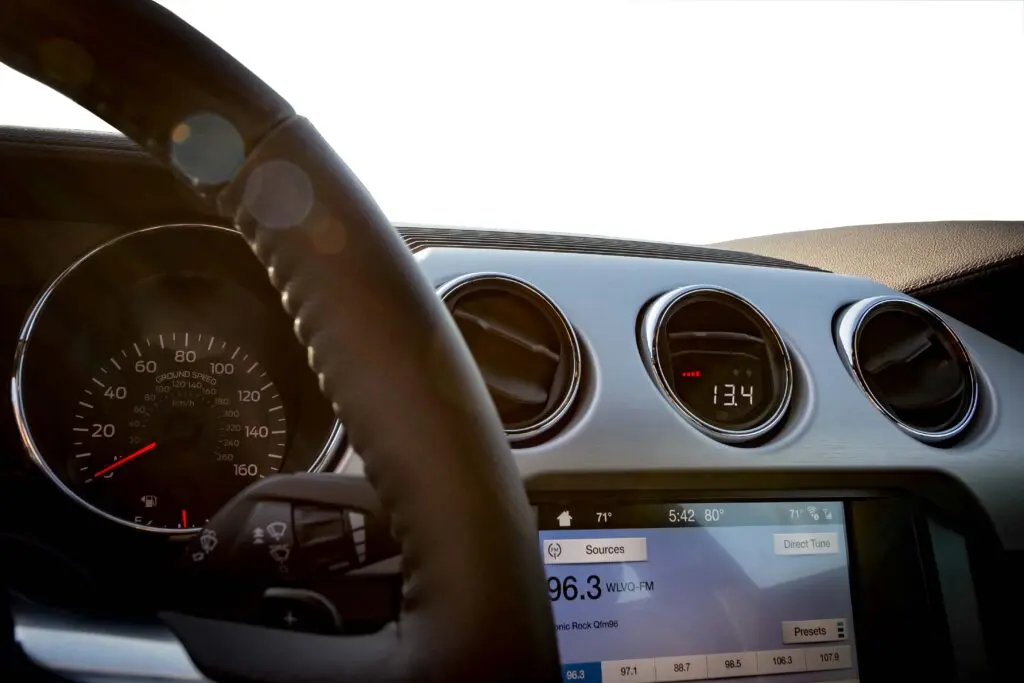
What Does a P3 Gauge Do?
A P3 Gauge is a multifunction digital gauge that mounts inside your dashboard vent, plugs into your OBD2 port, and gives you real-time data on boost, engine temperatures, performance timers, diagnostic codes, and a long list of other engine parameters. The main reason people care about these gauges has less to do with the data and more to do with how they look. Unlike other aftermarket monitoring options, a P3 Gauge will blend into the interior like it came from the factory.
Here’s the longer version of what a P3 Gauge actually does and why people choose it over the alternatives.
What you can monitor with a P3 Gauge
The current P3 V3 OBD2 multifunction gauge reads data through your factory OBD2 port and displays it on a small, bright screen integrated into your dashboard vent. The list of values it can pull is long for a unit this small:
- Boost pressure (through OEM sensors via OBD2, or through P3’s optional analog boost sensor for higher-boost setups reading up to 80 PSI)
- Coolant temperature
- Intake air temperature
- Exhaust gas temperature
- Throttle plate position
- RPM with configurable shift light
- Vehicle speed
- Battery voltage
- 0-60 and 0-100 performance timers
- Ethanol content (on units built after July 2022, when an OEM flex fuel sensor is present)
- Diagnostic trouble codes (DTCs) read and cleared on the fly
There’s also support for two 0-5 volt analog inputs, which lets you wire in external sensors for things the OBD2 port doesn’t expose, like aftermarket oil pressure, oil temperature, or wideband AFR. That matters for built engines and forced induction cars where the factory ECU isn’t reading what you actually want to monitor.
You configure all of it through an on-the-fly menu without pulling the gauge or plugging into a laptop. Switch units (PSI/BAR, F/C, MPH/KPH), change which value displays in which slot, set a shift light point, calibrate sensors. It’s all on the gauge.
Why it looks the way it does (and why that matters)
Most aftermarket gauges look aftermarket. Pillar pods, A-pillar mounts, suction cups stuck to the windshield. They get the data, but they advertise to anyone in the cabin that the car has been modified, and they make the interior look like a parts catalog.
P3’s whole approach is the opposite. They build vehicle-specific gauges that mount inside the factory air vent for that specific vehicle. The display sits flush with the vent louvers, the housing matches the OEM trim, and the air still flows through normally. From the driver’s seat it reads as part of the car, not something added to it.
That design choice is what most owners actually buy a P3 for. The data is widely available; you can get a lot of these readings from cheaper OBD2 dongles paired with phone apps, or from any number of pillar pod gauge kits. What you can’t get from those is the “looks like it came that way” install, which is why we’ve installed a lot of P3 Gauges on cars at our Lewis Center and Hilliard locations where the owner specifically didn’t want to see the modification from the driver’s seat.
Plug-and-play install (mostly)
The P3 V3 OBD2 gauge installs by plugging directly into your factory OBD2 port and seating into your dashboard vent. There’s no cutting, no drilling, and on most vehicles no permanent modification. If you sell the car later, the gauge comes out and the original vent goes back in.
A few real things to know about the install:
- OBD2 port stays usable, sort of. The gauge plugs into the port, which means anything else that wants to use it (a code reader, an aftermarket tuner with a constant connection) will conflict. P3 sells a hard-wire harness kit that runs the gauge off direct power and ground instead, freeing the OBD2 port back up. That’s a slightly more involved install but worth it if you run other devices.
- Vent fitment is vehicle-specific. Some applications ship with the gauge pre-mounted in an OEM vent ring; others require you to swap your existing vent or trim the OEM vent to accept the unit. Which one you get depends on your year, make, and model. We check this for the customer before ordering so the right kit shows up.
- It’s not a five-minute job on every vehicle. A plug-and-play OBD2 install with a pre-mounted vent is genuinely quick. A hard-wire install on a vehicle that needs trim work to seat the vent is a couple of hours. We do all installs in-shop because the trim removal on a lot of modern dashboards has hidden clips that break easily without the right tools.
Who actually benefits from a P3 Gauge
This is where most articles overcomplicate things. The honest breakdown:
- Forced induction owners (turbo or supercharged). Real-time boost monitoring is the original use case, and it’s still the strongest one. If you’re running a tune, aftermarket boost hardware, or any engine where pressure outside the safe range will damage things, having boost on the dash where you can actually see it is the point. With the optional analog boost sensor, the V3 reads up to 80 PSI, which covers built engines and high-boost setups.
- Tuned daily drivers. A car with even a basic tune benefits from being able to see coolant temps, intake air temps, and throttle behavior at a glance. Modern dashboards hide most of this. The gauge brings it back.
- Track day and autocross drivers. The 0-60 and 0-100 timers, peak recall, and RPM with configurable shift light are useful for actual driving feedback during sessions.
- Owners who want diagnostic capability without a separate scanner. Reading and clearing DTCs from the gauge means you don’t need a separate code reader in the glovebox. This is especially handy on cars that throw nuisance codes after modifications.
If your vehicle is bone stock and you don’t have any specific reason to monitor a parameter, you probably don’t need a P3 Gauge. It’s purpose-built equipment for owners who actually use the data, and there’s no shame in not needing it.
Common questions we get about P3 Gauges
Will a P3 Gauge fit my car or truck?
P3 makes vehicle-specific applications for a wide range of platforms, including BMW, Audi, VW, Porsche, Ford (Mustang and F-150), Chevy (Camaro, Corvette), Cadillac CTS-V, Honda Civic, Subaru WRX/STI, and others. Fitment is by year, make, and model, and not every vehicle has a P3 application. The fitment list shifts as P3 develops new applications, so we’ll confirm what’s available for your specific vehicle when you come in.
Does a P3 Gauge throw codes or affect my warranty?
The OBD2 install draws data from existing OEM sensors and doesn’t modify the engine or its calibration. It generally doesn’t trigger codes or affect engine operation. As with any aftermarket electronic device, dealers can decline a warranty claim if they determine an aftermarket part caused a specific failure, but a passive monitoring gauge is a low-risk install in that context. If a hard-wire harness was used, the wiring would need to be removed for a clean warranty visit.
Can I install a P3 Gauge myself?
On vehicles where the gauge ships pre-mounted in an OEM vent and the OBD2 install is straightforward, yes. On vehicles that require dash trim removal or a hard-wire harness, the installation is more involved and trim damage is the most common DIY mistake. We see this happen often enough that we usually recommend a shop install on anything past the basic plug-and-play applications.
Ready to talk through a P3 Gauge install for your vehicle?
If you want real-time engine data on a display that actually looks like it belongs in your car, a P3 Gauge is the cleanest way to get it. Stop by our Lewis Center or Hilliard location and we’ll confirm fitment for your specific year, make, and model, walk through the install options, and get you a quote. You can also see our P3 Gauge service page here.

STAY CONNECTED
Follow us online to keep up on future updates, discounts, new products, and new projects.


