
Wheel Alignments: How They Improve Your Driving Experience
Out-of-balance tires announce themselves. The steering wheel shakes, the seat buzzes, and you know something’s wrong. A bad alignment is sneakier. It creeps in slowly enough that most drivers adapt without realizing. You hold the steering wheel slightly off-center to go straight, you fight a small pull on the highway, and your tires wear out 10,000 miles earlier than they should. You stop noticing because the brain is good at adapting to small problems. The alignment job that fixes all of that is one of the most underrated services a vehicle gets, and it changes how the car drives the moment you leave the lot.
Here’s what a wheel alignment actually does for the driving experience, when you need one, and why most people don’t realize they should have had one already.
What an alignment changes about how the vehicle drives
A wheel alignment adjusts the angles of your suspension so the wheels point exactly where they should relative to the road and each other. When those angles match the manufacturer’s specifications, four things change in how the vehicle drives:
- The vehicle tracks straight without you fighting it. A properly aligned vehicle goes where you point it. On a flat, smooth road with no crosswind, you should be able to hold the steering wheel with light fingertips and drive in a straight line. If you’re constantly making small corrections, or holding the wheel slightly off-center to compensate for a pull, the alignment is off. Most drivers don’t notice this until they get into a freshly aligned vehicle and feel the difference.
- The steering feels precise instead of vague. Bad alignment, especially incorrect caster, makes the steering feel disconnected. The vehicle doesn’t return to center cleanly after a turn. Small steering inputs don’t translate to the road the way they should. After an alignment, the steering “wakes up.” This is the change customers comment on most often when they come back from a test drive.
- The vehicle stays planted in turns. Camber and caster work together to keep the tire’s contact patch maximized when you steer. Out of spec, the tire tilts incorrectly and gives up grip earlier than it should. You may not notice this in normal driving, but you’ll feel it the first time you take an off-ramp or change lanes quickly.
- Tire wear evens out. This is the consequence most people understand but underestimate. Misalignment can wear a tire to the cord in under 10,000 miles. We’ve seen customers come into our Lewis Center and Hilliard locations with new tires installed less than a year ago that need to be replaced because the previous shop skipped the alignment after suspension work.
The signs your alignment is off
Most drivers don’t get an alignment because they thought of it; they get one because something prompted them. The most common signs:
- Steering wheel is off-center when driving straight. This is the easiest one to spot. If you have to hold the wheel turned slightly left or right to track straight on a level road, the alignment is off. The wheel should sit centered.
- The vehicle pulls to one side. On a flat, crowned road, vehicles will drift slightly to the right (because roads are crowned to drain water). That’s normal. A pull that requires active correction is not.
- Uneven tire wear. Specifically, inner-edge or outer-edge wear (camber issue) or feathered wear across the tread (toe issue). Center wear is overinflation, not alignment. Cupping is balance or suspension. The wear pattern tells you which angle is off.
- Vibration, but only on turns or under braking. Pure highway-speed vibration is usually balance. Vibration that comes in when turning or braking is more likely alignment or suspension component related.
- Squealing tires in normal turns. This happens when the toe is out of spec. The wheels point slightly inward or outward instead of straight ahead, so the tires scrub sideways across the pavement every time you turn. Loud enough that you notice in parking lots.
- After any hit. Curb strike, pothole, minor collision, anything that jolted the suspension hard. Alignment can be knocked off by a single impact.
Why misalignment happens
It’s not always something dramatic. The most common causes we see:
- Curb strikes and potholes. Central Ohio’s freeze-thaw cycle produces some of the worst pothole damage we see in the Midwest. After every winter, we get a wave of customers in for alignment work because of impacts they barely noticed at the time.
- Suspension component wear. Bushings, ball joints, tie rod ends, and control arm bushings all wear over time. As they wear, the geometry shifts. You can align the vehicle, but the alignment won’t hold if the underlying components are loose.
- Any suspension or steering work. Lift kits, lowering, shock or strut replacement, tie rod replacement, and control arm replacement. Every one of these throws the alignment off. Skipping the alignment after suspension work is one of the most common mistakes we see at the shop.
- New tires. Not because the tires cause misalignment, but because new tires are the right time to verify alignment. Putting new tires on a misaligned vehicle is throwing money away.
- Gradual settling. Even without impacts or repairs, alignment drifts slightly over time as bushings compress and components age. By 50,000 miles, almost every vehicle benefits from at least a check.
How often you actually need an alignment
You’ll see wildly different numbers on this depending on who you ask. The honest answer is that the right interval depends on how and where you drive. Some realistic guidelines:
- Every 12,000 to 15,000 miles or once a year for most daily drivers on paved roads in normal conditions. This matches what most automotive sources recommend as a general maintenance interval.
- Every 6,000 to 10,000 miles if you drive on rough roads, gravel, or you commute on Central Ohio’s pothole-heavy roads after winter.
- After any impact that felt significant at the time. Curb strike, deep pothole, minor accident.
- After any suspension or steering work. Non-negotiable. This includes tire replacements that involved removing suspension components.
- Anytime you notice the steering wheel off-center, a pull, or unusual tire wear. Don’t wait for the next interval.
Manufacturer recommendations vary; some suggest as often as every 6,000 miles paired with tire rotation, others say two to three years. Check your owner’s manual for what your specific vehicle calls for, but treat that as a floor, not a ceiling.
What an alignment actually measures
The technical side, in plain English. A modern alignment machine measures three angles on each wheel:
- Camber. The inward or outward tilt of the wheel viewed from the front. Out of spec causes inner or outer edge tire wear and affects cornering grip.
- Caster. The forward or backward angle of the steering pivot viewed from the side. Out of spec affects steering feel, return-to-center, and stability at speed. Less commonly affects tire wear.
- Toe. Whether the wheels point straight ahead, slightly inward (toe-in), or slightly outward (toe-out) viewed from above. Toe out of spec causes the fastest tire wear of all three angles, because it’s literally dragging the tires sideways.
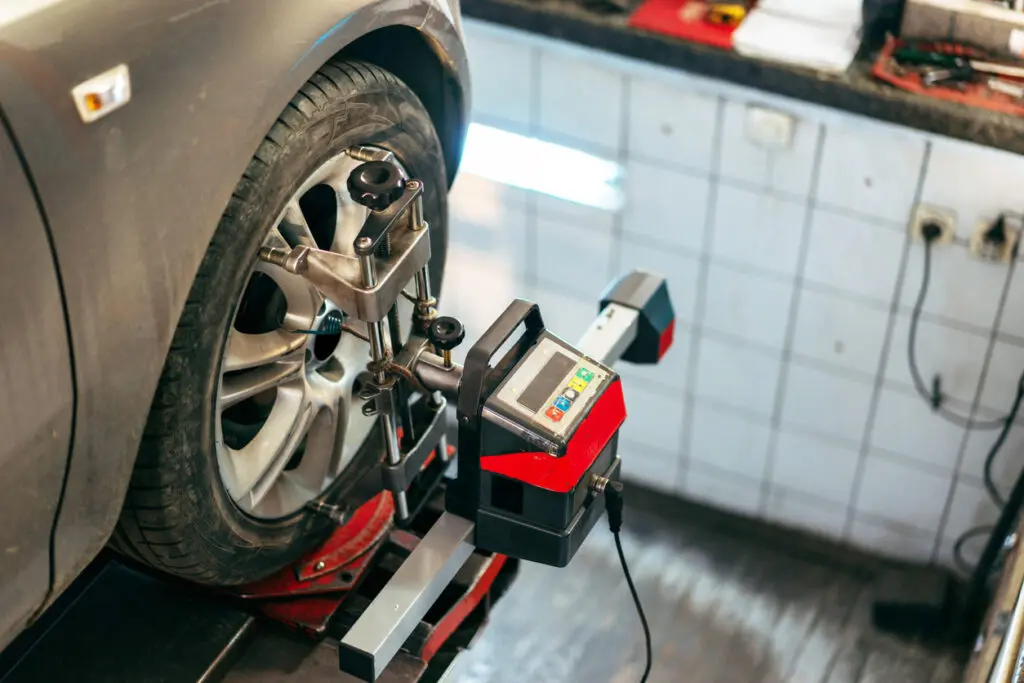
The machine compares actual measurements to your vehicle’s factory specifications. Modern alignment machines (Hunter, Bee Line, John Bean) use laser or imaging sensors and produce a printout showing before-and-after numbers. A good shop will hand you that printout.
Why trucks, lifted vehicles, and EVs are different
A few specific cases where alignment matters more than usual:
- Lifted or leveled trucks. Changing ride height changes alignment geometry. Some suspension lifts include adjustable upper control arms specifically to allow proper alignment after the lift. Without those adjustments, you can’t bring the angles back to spec, and you’ll burn tires fast. We won’t deliver a lifted truck without verifying and correcting alignment on the same visit.
- Vehicles with larger aftermarket wheels and tires. Bigger tires magnify any alignment issue. The same toe error that’s barely noticeable on stock 17-inch wheels can produce dramatic wear on 35-inch off-road tires.
- Electric vehicles. EVs are heavier than equivalent gas vehicles because of the battery, and the regenerative braking puts different forces through the suspension. Tire wear tends to be more aggressive on EVs, which makes alignment even more important. We’re seeing this come up more often as more EVs hit the local roads.
Common questions we get about wheel alignments
Is an alignment the same as a tire rotation?
No. A rotation moves tires to different positions on the vehicle to even out wear. An alignment adjusts the suspension geometry so the wheels point correctly. Different services, different equipment, different price points. Both are routine maintenance; neither replaces the other. Most shops bundle them together because they’re both touching the wheels anyway.
Will an alignment fix my tire vibration?
Probably not. Vibration that comes in at highway speeds is almost always a balance issue, not alignment. Vibration that shows up only on turns or under braking can be alignment, suspension, or brake-related. We diagnose first and recommend the right service rather than guessing.
How long does a wheel alignment take?
A standard four-wheel alignment runs about 45 minutes to an hour and a half, depending on the vehicle and whether anything needs adjustment beyond a simple toe correction. Lifted trucks, vehicles with worn suspension components, or anything with non-standard geometry takes longer because more parts need to be checked and sometimes loosened to make the adjustment.
Ready to find out if your alignment is off?
If your steering wheel sits off-center, your vehicle pulls, or your tires are wearing on one edge, an alignment is almost certainly part of the answer. Stop by our Lewis Center or Hilliard location, and we’ll put your vehicle on the alignment rack, show you the actual numbers compared to factory spec, and let you know whether you need an alignment or something else entirely. You can also see our alignment services here.

STAY CONNECTED
Follow us online to keep up on future updates, discounts, new products, and new projects.


