
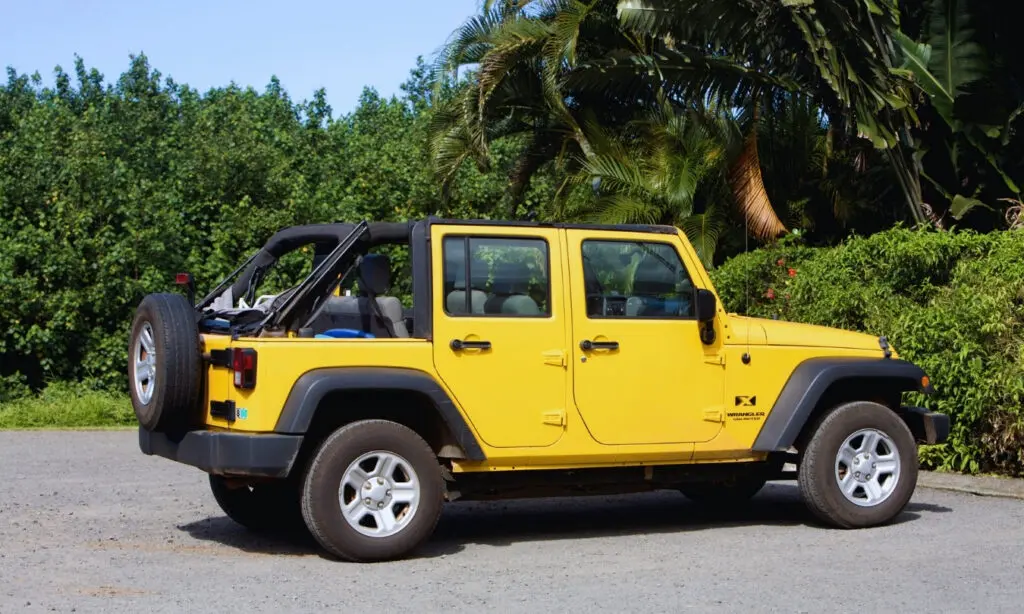
Is It Worth Removing Your Hard Top for Summer?
Yes. If you bought a Jeep Wrangler or a Ford Bronco with a removable hard top and you’re leaving it on all summer, you’re sitting on the best feature of the vehicle and not using it. Open-air driving is the entire reason these things are built the way they are. The only real reason people don’t do it is the hassle of getting the top off, finding somewhere to put it, and the worry about damaging an expensive panel in the process. Here’s the honest breakdown of what’s actually involved, which parts are easy, which parts aren’t, and why the part that stops most people is the part you don’t have to do yourself.
The front panels are easy, and everyone should be doing this
If you’ve never taken any of your top off, start here, because this part is genuinely simple. Both the Jeep Wrangler’s Freedom Panels and the Ford Bronco’s molded hard top use the same basic idea up front: a pair of roof panels over the front seats that release with a few latches.
The numbers make the case. Each front panel weighs roughly 15 pounds, light enough for one person to handle, and they pop off in under five minutes once you know the latches. On a Jeep you flip down the sun visors, release the L-shaped locks and levers, and lift. On a Bronco, the front panels come off in a similar quick-release fashion. No tools, no help needed.
For a lot of owners, pulling just the front panels on a nice day is the move. You get the open-air feel directly over the seats, you can throw them in the back or in a storage bag, and you can put them back on in minutes if the weather turns. If that’s all you ever do, you’re already getting most of the experience. We see plenty of Jeep and Bronco owners who run front-panels-off as their default all summer and never touch the rear section.
The rear section is where it gets real
Here’s the part nobody tells you until you’re standing in your driveway sweating. The rear hard top section is a completely different job from the front panels.
On a four-door Bronco, the panel over the rear seats alone spans the full width of the vehicle and weighs 30 pounds, and that’s before you get to the large rear cap. On a Jeep Wrangler, the full rear hard top section is heavier still and awkwardly shaped, the kind of thing that’s genuinely difficult for one person to handle without risking either the top or their back.
What the rear removal actually involves:
- Tools. Unlike the tool-free front panels, the rear section is bolted down. You’ll need a T40 Torx driver and a ratchet to remove the bolts at the corners and along the back.
- Two people, realistically. The rear section is heavy and unwieldy. Lifting it straight up and off without scraping it against the body or dropping it is a two-person job unless you’ve invested in a removal hoist or cart.
- Wiring and washer lines. The rear section usually has a defroster connection and rear wiper/washer line that have to be disconnected before the top comes off, and reconnected when it goes back on. Get this wrong and you’ve got a non-working rear wiper or worse.
- Damage risk. This is the one that actually costs money. A hard top dragged against the body chips paint. A panel set down wrong cracks. A top stored improperly warps or develops stress cracks. These aren’t cheap to fix.
In our experience, this is the exact point where the “should I take the top off” enthusiasm meets reality and the top stays on. People do it once, find it’s a hassle and a little nerve-wracking, and leave it on the next summer. That’s a shame, because the rear-off configuration is where the vehicle really opens up.
The storage problem
Say you get the whole top off cleanly. Now you’ve got a large, expensive, fragile object that needs to live somewhere for three or four months.
A hard top can’t just lean against the garage wall in the corner. Stored wrong, fiberglass and composite tops warp, crack, or develop stress fractures, and the headliner and seals can grow mold if there’s any moisture. Proper storage means the top is held in the right orientation, padded at contact points, kept off the floor, and protected from temperature and humidity swings.
The aftermarket has solutions: freestanding storage carts and ceiling hoist systems exist that hold a top safely and even make removal a one-person job. They work well. The catch is they cost real money and they take up a chunk of garage space, which is the thing a lot of people were trying to free up by taking the top off in the first place. If you’ve got the room and you want to own the equipment, great. A lot of owners don’t, or would rather not.
Why you don’t actually have to deal with any of this
This is the part most articles skip, because most articles aren’t written by a shop that does it. The entire removal-storage-reinstall headache is something you can simply hand off.
Our TopKeep Storage service exists for exactly this reason. We handle the top removal, the climate-controlled storage through the warm months, and the reinstallation when the weather turns, on both Jeep Wrangler and Ford Bronco. The top gets removed properly with the right tools and the right number of hands, stored somewhere it won’t warp, crack, scratch, or grow mold, and put back on cleanly when summer’s over. If anything is damaged during removal, storage, or reinstallation, we address it.
That’s the answer to “is it worth removing your hard top for summer.” The driving is absolutely worth it. The removal and storage hassle is the only real downside, and it’s a downside you can opt out of entirely.
Common questions we get about hard top removal
Can I just take the front panels off and leave the rest?
Absolutely, and a lot of people do. The front Freedom Panels (Jeep) or front roof panels (Bronco) come off in minutes with no tools and store easily, even in a bag behind the seats. Running front-panels-off is the lowest-effort way to get open-air driving, and you can pop them back on the second it starts to rain. If you’re on the fence, this is the no-commitment way to try it.
Will removing my hard top hurt my Jeep or Bronco’s resale value?
No, as long as the top is stored properly and reinstalled correctly. The factory hard top is part of the vehicle’s value, so the key is keeping it in good condition rather than letting it warp or crack in a corner of the garage. A top that’s been professionally stored and comes back on cleanly protects that value. A top that’s been damaged through bad storage is what costs you at resale.
What happens if it rains while my top is off?
If you’ve only got the front panels off, you snap them back on in a couple of minutes, and you’re covered. If the full top is off and in storage, that’s where having a plan matters. Some owners keep a soft top or bikini top for exactly this, and a full hard-to-soft swap for the summer is a common setup. We can talk through whether a soft top swap makes sense for how you actually use the vehicle.
Ready to go topless this summer without the hassle?
If the only thing keeping your top on is the work of getting it off and finding somewhere to put it, that’s a solved problem. Stop by our Lewis Center or Hilliard location and we’ll walk through removal, storage, and getting it back on when the season ends, so you can actually enjoy the vehicle you bought. You can also see our TopKeep Storage service here.

STAY CONNECTED
Follow us online to keep up on future updates, discounts, new products, and new projects.


